
EKITI 2026: EU OBSERVERS ISSUE FINAL WARNING AS STATE PREPARES FOR HISTORIC POLL
...First major test of Nigeria's new Electoral Act as 1 million voters decide next governor on Saturday

By Olugbolade Ogboro-Cole,
Ado-Ekiti
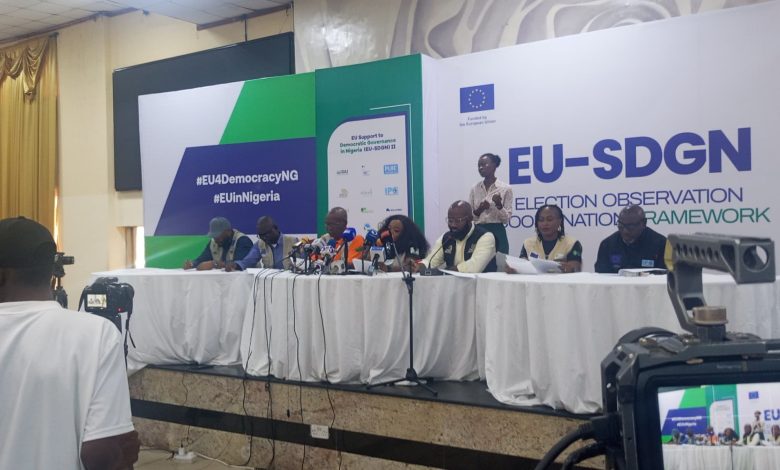
The European Union Support to Democratic Governance in Nigeria (EU-SDGN) Election Observation Hub has sounded a clarion call to all stakeholders ahead of Saturday’s Ekiti State governorship election, warning against vote-buying, political thuggery, and the spread of dangerous disinformation that could undermine the credibility of the historic poll.

In a pre-election statement issued on Friday in Ado Ekiti, the observation hub – comprising six prominent civil society organisations including The Kukah Centre, Yiaga Africa, and the International Press Centre – described the election as a “critical performance test” for Nigeria’s newly enacted Electoral Act 2026, making it a dress rehearsal for the 2027 general elections.

With 1,059,360 registered voters and an impressive 97.1% PVC collection rate, the battle for the governorship seat will see 13 political parties slug it out across 2,445 polling units in the state’s 16 Local Government Areas.
The EU-SDGN Hub commended INEC for completing eight of nine scheduled pre-election activities, including the configuration of BVAS machines and deployment of personnel. However, observers expressed concern that the mock accreditation exercise did not test transmission to the INEC Results Viewing Portal (IReV) – a crucial component for ensuring transparent results.


Security agencies have been placed on high alert, with the Nigeria Police Force assuring stakeholders of comprehensive security arrangements. However, the Hub identified Ado-Ekiti as vulnerable to urban electoral violence, while Ikole, Moba, and Ilejemeje LGAs face exposure to cross-border criminal activities including kidnapping.
In a strongly-worded warning, the observation group raised the alarm over organised vote-buying schemes involving pre-credited bank accounts and harvesting of PVC and NIN details in Irepodun/Ifelodun, Ikole, Ikere, Ekiti East and Ekiti West LGAs.
The statement also condemned alleged police detention of political opponents through the use of FORM K without judicial recourse, describing such actions as undermining voter confidence and public trust.
The information space has become a battlefield, with observers flagging the spread of misinformation and inflammatory content across Facebook, WhatsApp, TikTok and X. Of particular concern are unverified claims of cloned PVCs being circulated to create confusion and political tension.
In a passionate appeal, the Hub expressed deep concern over the limited attention given to women and persons with disabilities, noting that women in rural communities remain particularly vulnerable to economic coercion and voter inducement. Observers called for deliberate measures to inform PwDs about assistive voting devices.
As Ekiti stands at the crossroads of history, the EU-SDGN Hub issued a stern call to action:
They urged INEC to ensure polling units open by 8:00 am, guarantee seamless electronic transmission of results, and activate the Security and Alert Notification System.
To political parties,the hub urged them to honour the Peace Accord, accept election outcomes, and pursue grievances through lawful channels – not violence.
Security agencies should avoid excessive militarisation and respond proportionately to incidents without partiality.
The hub charged media practitioners to verify all information and avoid reporting unofficial results.
To the electorate they were charged to come out in large numbers and vote their conscience, free from inducement or intimidation.
“The Ekiti State Governorship Election of 20th June 2026 is an important milestone as the first major poll under a new electoral legal framework,” the Hub declared, adding that all stakeholders must “discharge their respective responsibilities with integrity, professionalism, and a sincere commitment to democratic principles.”
The observation group will issue an Election Day statement and Post-Election report following the declaration of results.
INEC has accredited 98 observer groups, 91 media organisations, and approximately 675 journalists to cover the election.