

Ekiti Takes Delivery of NADF Emergency Farm Packages for 4,000 Flood Victims
Oyebanji's agric agenda gets federal boost as Fajana, Boluwade flag off recovery intervention

By Olugbolade Ogboro-Cole
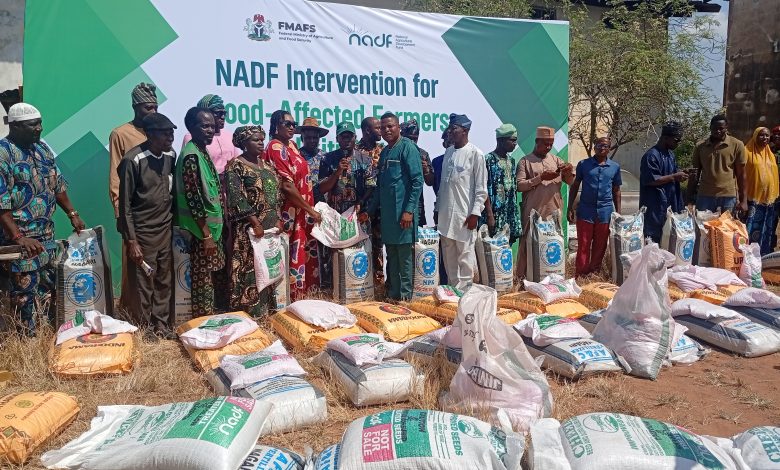
Ekiti State has taken delivery of emergency agricultural recovery packages from the National Agricultural Development Fund for 4,000 flood-affected smallholder farmers in the state, comprising 1,200 rice farmers and 2,800 maize farmers. The packages include 4,000 bags of NPK fertiliser, 4,000 bags of urea, 2,800 bags of rice seeds, 1,200 bags of maize seeds, 4,000 bottles of pre-plant chemicals, 4,000 bottles of pre-emergency chemicals, 4,000 bottles of early post-emergency chemicals and 4,000 bottles of insecticide.

Receiving the inputs on behalf of the Ekiti State Government at the L-Pres office Agric Olope area in Ado Ekiti on Friday, the Special Adviser on Agriculture and Food Security, Mr. Ebenezer Boluwade, expressed profound appreciation to NADF for the timely and commendable intervention aimed at alleviating the impact of flooding on farming communities in the state. He said the recent flooding disrupted agricultural activities, destroyed farmland and crops and negatively affected the livelihood of many smallholders, making the intervention not only timely but a significant step towards restoring the productive capacity of affected farmers and strengthening food production in Ekiti.

Boluwade said the gesture aligns with the agricultural development agenda of Governor Biodun Oyebanji, whose administration recognizes agriculture as a critical driver of economic growth, food security, employment generation and poverty reduction, and remains committed to creating an enabling environment for farmers through strategic interventions, partnerships, infrastructure improvement, mechanisation support and extension services.
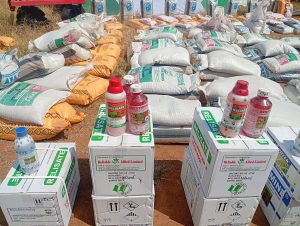

The special adviser appealed to beneficiaries to make judicious use of the inputs, stressing that the materials are intended to support genuine recovery and increase farm productivity. He urged relevant officials, community leaders and stakeholders involved in implementation to ensure transparency, accountability and fairness in distribution so that intended beneficiaries receive the full benefit of the programme.
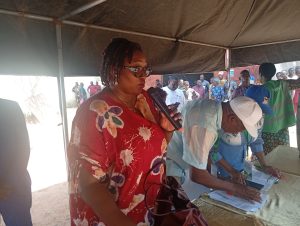
He assured NADF that Ekiti State, through the Ministry of Agriculture and Food Security, will provide intensive cooperation, coordination and logistic support to ensure successful implementation, expressing confidence that the support will go a long way in restoring the confidence of affected farmers, improving agricultural production and contributing to the food security objectives of the state. Boluwade thanked NADF and commended all stakeholders who contributed to making the initiative a reality, saying that together a resilient agricultural sector can be built that empowers farmers and ensures sustainable food security.
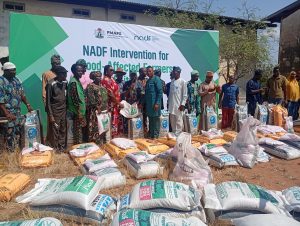
In his keynote address, the Executive Secretary and Chief Executive Officer of NADF, Mr Muhammed Abu Ibrahim, represented by the Head of Strategy, Planning, Mrs. Adebanke Fajana, who announced the figures at the flag-off of the intervention in Ado-Ekiti, said the programme is structured around three fundamentals: a needs assessment and verification exercise in collaboration with affected states, an emergency farm input support package, and a climate-smart recovery measure guided by the principle of building back better.
Fajana said the warning signs were evident long before the floods, with the 2026 annual flood outlook by the Nigerian Hydrological Services Agency identifying thousands of communities at high, moderate and minimal risk, the Nigerian Meteorological Agency predicting significant rainfall variability with heightened flood threats in July, and the National Emergency Management Agency listing Ekiti among locations facing elevated flash flood risk.
She said farms were inundated, productive assets damaged, livelihoods disrupted and months of hard work lost within days, leaving thousands of smallholders vulnerable. She explained that without timely intervention, a disaster measured in days could easily become a crisis that lasts for seasons, adding that NADF’s mandate covers responding to emergency situations, improving agricultural finance, increasing food production, strengthening farmer resilience and promoting climate-smart agriculture.
The NADF head of strategy said the fund had previously supported over 2,000 flood-affected onion farmers in Sokoto, Kebbi, Borno and Yobe States and provided inputs to 5,000 ginger farmers in Kaduna State, Nasarawa State and the FCT through the Ginger Recovery, Advancement and Transformation for Economic Empowerment grant programme. She said the present intervention builds on that experience and emphasises the fund’s commitment to ensuring hardworking farmers are not left in the lurch after a disaster. She stressed that resilience is not measured by the absence of shocks but by the speed of recovery, and that speed is critical in emergency response while accountability is equally important.
Every beneficiary will be properly verified, a comprehensive database will be developed, and implementation will be monitored through the NADF monitoring and evaluation framework from procurement to distribution.
The programme is to be delivered within a seven-week timeline because timing is of the essence in agricultural emergencies. Fajana expressed appreciation to the Ekiti State Government for the partnership and commended NiMet, NEMA and other agencies for the data, forecasts and early warning information guiding evidence-based response.
Officials said beneficiaries will be verified, materials will be branded not for sale to reduce diversion, and technical guidance will accompany the inputs so yields improve and the state’s agricultural investment delivers measurable returns. State officials, farmer associations and local leaders are expected to monitor distribution and provide feedback to ensure genuine flood-affected farmers benefit without delay and without discrimination.
In an interview, immediate past Technical Adviser to the Governor on Youth Inclusion, Hon. Ayo Ojo, noted that the gesture is in furtherance of Governor Oyebanji’s drive to make food available and affordable for residents and reflects the youth inclusion mantra that youths must be seen, heard, supported and valued, with young farmers and youth-led agricultural enterprises expected to benefit from the recovery packages.